




For many healthcare providers, CAQH management is one of the most overlooked yet essential parts of the credentialing and payer enrollment process. While it may seem like a routine administrative task, inaccurate or outdated CAQH profiles can lead to delayed enrollments, claim denials, interrupted reimbursements, and compliance risks for medical practices.
The Council for Affordable Quality Healthcare (CAQH) serves as a centralized database that stores provider information used by insurance companies during credentialing and recredentialing. Insurance payers rely heavily on CAQH data to verify provider credentials, practice details, work history, licenses, malpractice coverage, and supporting documentation. When this information is incomplete or inconsistent, enrollment applications are often delayed or rejected.
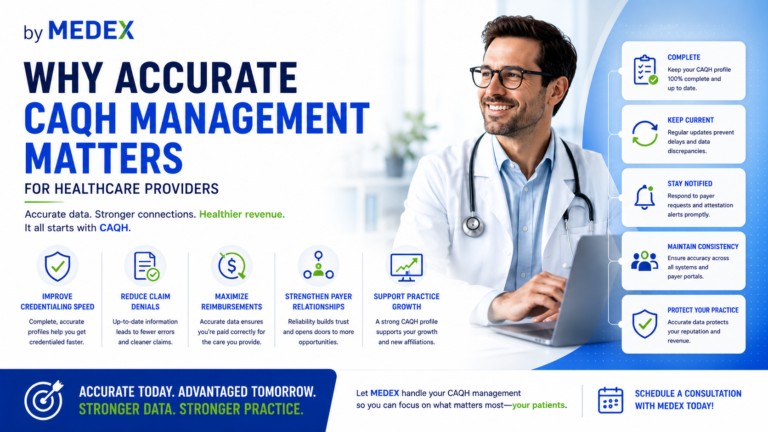
One of the most common issues healthcare practices face is expired or missing documentation within the CAQH profile. State licenses, DEA certificates, malpractice insurance, board certifications, and supporting documents must be updated regularly. Even a small discrepancy between CAQH data and payer applications can trigger verification problems that slow down approvals.
Another challenge is attestation. Providers are required to attest and confirm their CAQH information every 120 days. Missing an attestation deadline may cause insurance companies to view the profile as inactive or outdated, potentially impacting payer participation and reimbursement timelines. Unfortunately, many busy providers and office managers overlook these reminders while handling daily operations.
Accurate CAQH management also directly impacts revenue cycle performance. Delayed enrollments often mean providers cannot bill insurance companies for services rendered until approvals are completed. This creates unnecessary financial strain for practices, especially for newly hired physicians or expanding clinics. Faster and more accurate CAQH maintenance helps reduce interruptions and accelerates payer approvals.
As healthcare organizations grow, managing multiple provider profiles becomes increasingly complex. Multi-location practices, telehealth providers, and specialty groups often deal with various insurance payers, credentialing requirements, and state-specific regulations. Without a structured system for monitoring CAQH updates, errors can quickly accumulate and create operational inefficiencies.
Many healthcare organizations now outsource CAQH management and credentialing support to experienced professionals who understand payer requirements and enrollment workflows. Professional credentialing teams can track deadlines, update documents, monitor profile accuracy, communicate with insurance companies, and help practices avoid costly delays.
In today’s competitive healthcare landscape, efficient credentialing processes are critical for maintaining steady cash flow, improving provider onboarding, and ensuring compliance with payer standards. Proper CAQH management is not just an administrative task — it is a foundational component of a healthy revenue cycle and a well-organized healthcare operation.
Practices that prioritize accurate CAQH maintenance position themselves for smoother enrollments, faster reimbursements, and long-term operational success.