





Medical billing plays a major role in the financial health of every healthcare practice. Even clinics with strong patient volume can experience cash flow problems if billing performance is not monitored carefully. Reviewing key billing metrics every month helps healthcare organizations identify issues early, improve collections, and maintain stable operations.
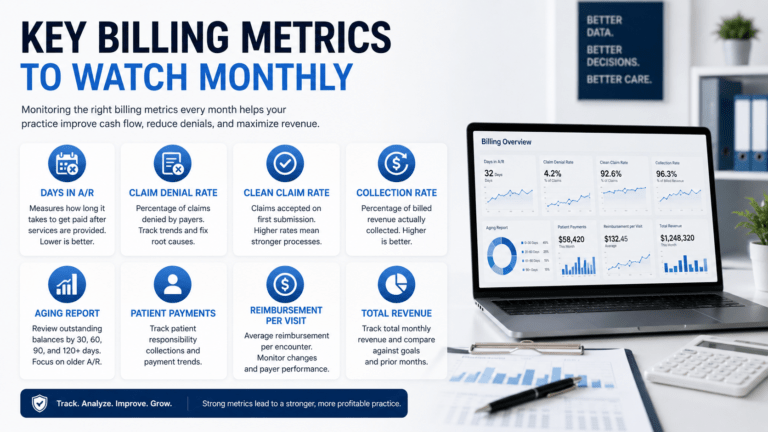
One of the most important metrics to monitor is Days in Accounts Receivable (A/R). This measures how long it takes for the practice to collect payments after services are provided. High A/R days may indicate claim delays, payer issues, or collection problems. Most healthy practices aim to keep A/R days as low as possible to maintain steady cash flow.
Claim denial rate is another critical metric.
Denied claims directly affect revenue and increase administrative workload. Tracking denial percentages monthly helps practices identify recurring issues such as coding errors, missing documentation, eligibility problems, or credentialing delays. Reducing denials improves reimbursement speed and operational efficiency.
Clean claim rate is closely connected to denial management.
A clean claim is a claim accepted by the payer on the first submission without corrections or rework. High clean claim rates usually indicate strong billing processes, accurate coding, and organized documentation. Improving clean claim performance reduces delays and administrative costs.
Collection rate is also essential.
This metric measures how much of the billed revenue is actually collected. Low collection rates may signal payer reimbursement problems, weak patient collections, or billing workflow issues. Monitoring this number monthly helps practices evaluate overall revenue cycle performance.
Practices should also review aging reports regularly.
Aging reports show outstanding balances grouped by time periods such as:
- 30 days
- 60 days
- 90 days
- 120+ days
Large balances in older aging categories may indicate follow-up problems or unpaid claims requiring immediate attention.
Patient responsibility collections have become increasingly important in modern healthcare.
High deductibles and out-of-pocket costs mean patients now carry a larger portion of healthcare expenses. Monitoring patient payment trends helps practices improve front-desk collections, payment plans, and communication strategies.
Another important metric is reimbursement per visit or encounter.
Tracking average reimbursement helps practices understand payer performance and service profitability. Sudden changes may reveal coding issues, contract problems, or reimbursement reductions.
At MedEx Practice Solutions, we understand that strong billing oversight is essential for long-term practice stability. Monthly reporting and consistent metric tracking help healthcare organizations make informed decisions, reduce revenue leakage, and improve financial performance.
In today’s healthcare environment, successful practices do not simply generate revenue — they actively monitor, manage, and optimize it every month.

Bài viết rất hữu ích, cảm ơn đã chia sẻ! Letco là công ty tư vấn du học Hàn Quốc uy tín, hỗ trợ trọn gói từ hồ sơ, visa đến học bổng. Tham khảo thêm tại letco.vn nhé.
Been meaning to comment for a while, and this post is spot on. While I’m here. If you bookmark https://zvre.tam512.com/, you’ll get a clean, no-nonsense job board — thousands of openings you can dig through without the clutter.
Not strictly on-topic, but useful. If you browse https://fwkz.9gfhgymkl.cc/, you’ll see a clean, no-nonsense job board — roles by city and company you can dig through without the clutter.
Nice article. There’s a good follow-up resource at 777-galaxy.com if you want to dig further.