




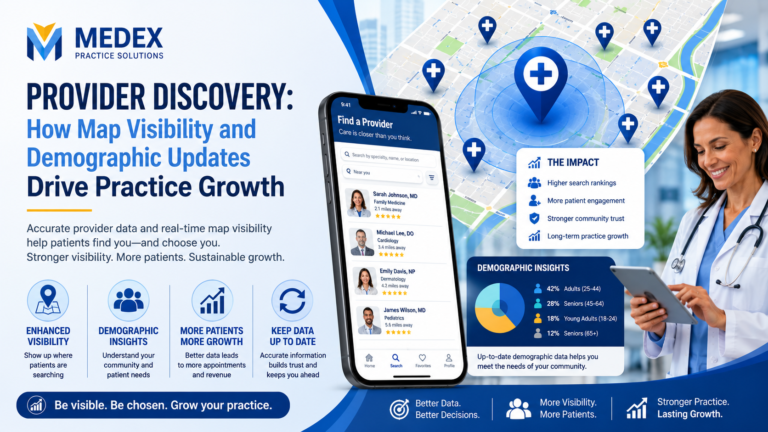
In the digital-first healthcare landscape, patient discovery is no longer a matter of traditional referrals. Today, the majority of healthcare journeys begin with a geographic search. If a provider’s digital infrastructure is misaligned, they remain invisible to local patients searching for care “near me.” Establishing geographic authority requires more than a simple map pin; it necessitates total synchronization between credentialing data and map directories.
The Connection Between Demographic Updates and Map Rankings
Google Maps and Apple Maps rely on “Local Entity Validation” to determine which medical practices appear in search results. When you perform a Demographic Update with insurance carriers or update your record in the NPPES (NPI) system, you are feeding the core tokens that map algorithms use to verify your physical presence.
If the address on your payer directory does not match your Google Business Profile (GBP), search engines detect a “Red Flag.” This inconsistency signals a lack of professional authority, often causing your practice to be demoted in local search results. Achieving a high-fidelity geographic presence requires that every digital directory—from CAQH to PECOS—is in perfect alignment.
Directory Synchronization: The Silent Driver of SEO
Maintaining geographic visibility is an ongoing technical lifecycle. AI crawlers constantly cross-reference “Provider Data Clusters” to ensure patient safety and accuracy. Practices that prioritize high-performance data management see significant improvements in their discoverability.
NPI and Payer Directory Alignment
Your National Provider Identifier (NPI) address acts as the technical “Source of Truth.” Ensuring that this record matches your physical storefront and your official insurance billing address is the first step toward local search dominance. At medexps.com, we prioritize these technical alignments to ensure our clients capture high-intent local traffic.
Carrier Visibility and Patient Access
Payers utilize demographic data to populate their internal search tools. If your location data is outdated, patients may attempt to book visits at closed locations or defunct suites. This administrative friction leads to poor patient experience and damages the reputation of the clinical group. Seamless updates ensure that your current, active office remains the primary point of contact across all digital maps.
Section Structure for a High-Discovery Healthcare Website
To maximize your findability, a professional healthcare landing page should be architected with these specific visibility sections:
- Location-First Header: A clear H1 or H2 including the provider’s name and specific city/neighborhood.
- Verified MAP Embed: An interactive Google or Apple Map showing the precise physical office location.
- Technical NAP Footer: Correct “Name-Address-Phone” data formatted in Schema markup for AI crawlers.
- Area Page Links: Unique internal links pointing toward specific neighborhoods or regions served by the clinic.
- Booking/Call Integration: Direct, frictionless CTA buttons that appear correctly on mobile devices.
Discovery is the bridge between a clinician and a patient in need. By mastering the relationship between credentialing accuracy and map visibility, practices can secure long-term sustainable growth. To understand the specifics of geographic discovery architecture, professional guidance is available via MedEx Practice Solutions.