
Opening New Medical Practice in California Neighborhood?
Opening a new medical clinic in California is exciting, but the provider credentialing process can quickly become overwhelming. Between payer applications, CAQH profiles, NPI registration, Medi-Cal enrollment, and state licensing requirements, even small mistakes can delay reimbursements for months.
This guide explains how credentialing works for new clinics in California, what documents you need, common delays to avoid, and how to accelerate enrollment with commercial insurance plans and government payers.
Why Credentialing Matters for New Clinics
Credentialing is the process insurance companies use to verify that your clinic and providers meet professional, legal, and operational standards before they allow you to bill for services.
Without completed credentialing:
- Claims may be denied
- Providers may appear out-of-network
- Patients may avoid scheduling
- Revenue cycles can stall
- Medi-Cal and commercial reimbursements may be delayed
For new clinics, credentialing is not just administrative paperwork — it is the foundation of your cash flow.
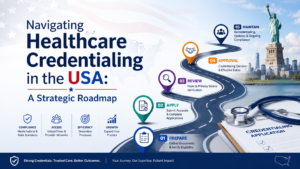
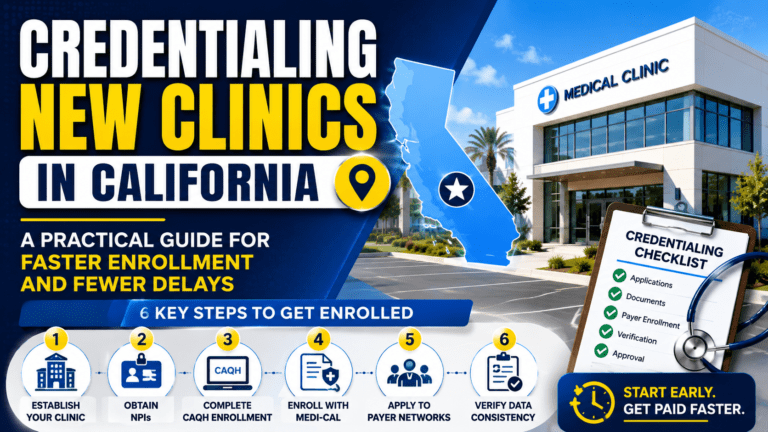
Step-by-Step Credentialing Process for California Clinics
1. Establish Your Legal Business Structure
Before payer enrollment begins, your clinic must have:
- Legal business entity (LLC, Corporation, or Professional Corporation)
- EIN from the IRS
- California Secretary of State registration
- Business bank account
- Malpractice insurance
- W-9 documentation
California professional entities must comply with Medical Board ownership rules and CPOM (Corporate Practice of Medicine) regulations.
2. Obtain NPIs for the Organization and Providers
Most new clinics require:
- Type 1 NPI for each provider
- Type 2 Organizational NPI for the clinic
Your Type 2 NPI becomes the central identifier for payer enrollment and claims processing.
Incorrect taxonomy selection is one of the most common causes of enrollment rejection.
3. Complete CAQH Enrollment
Most commercial payers in California rely heavily on CAQH ProView.
Your CAQH profile should include:
- Current licenses
- DEA certificates
- Board certifications
- Work history
- Hospital affiliations
- Malpractice history
- Practice locations
Even small inconsistencies between CAQH and payer applications can trigger delays.
4. Enroll with Medi-Cal
California clinics serving Medicaid populations must complete Medi-Cal enrollment through DHCS.
This process may include:
- Ownership disclosures
- Fingerprinting
- Site inspections
- Background verification
- Rendering provider setup
Medi-Cal enrollment timelines are often longer than commercial payer enrollments, especially for multi-provider clinics.
5. Apply to Commercial Insurance Networks
Most clinics prioritize:
- Blue Shield of California
- Anthem Blue Cross
- Aetna
- Cigna
- UnitedHealthcare
- Health Net
Each payer has unique contracting standards, processing timelines, and provider participation requirements.
New clinics frequently underestimate how long payer contracting can take. In California, commercial enrollment may take anywhere from 60 to 180+ days depending on specialty and region.
6. Verify Address and Data Consistency
Modern payers now use automated validation systems to compare provider data across:
- CAQH
- NPPES
- State licensing boards
- IRS records
- PECOS (for Medicare providers)
If your address formatting differs between systems — such as “Suite 101” versus “Ste 101” — applications may enter manual review.
Data consistency is now critical.
Common Credentialing Problems for California Clinics
Delayed Provider Licenses
California licensing boards can experience backlog delays, especially for new graduates or interstate providers.
Without active licensure, payer enrollment cannot move forward.
Incomplete CAQH Profiles
Missing malpractice history, expired attestations, or incomplete work history commonly stall applications.
CAQH should be reviewed monthly during enrollment periods.
Incorrect Taxonomy Codes
Using the wrong taxonomy can cause:
- Network mismatch
- Claims denial
- Incorrect specialty assignment
- Payment delays
Always verify taxonomy alignment with your actual services.
Group-to-Provider Linking Errors
Payers must correctly connect:
- Individual providers
- Organizational NPIs
- Tax IDs
- Service locations
If one link fails, claims may process incorrectly even after approval.
Best Practices for Faster Credentialing
Start Early
Credentialing should begin at least 90–120 days before opening your clinic.
Waiting until after launch creates avoidable revenue delays.
Maintain a Single Source of Truth
Keep all provider data centralized and synchronized across:
- CAQH
- NPPES
- Insurance applications
- State licensing systems
- Internal HR records
This reduces discrepancies and payer audits.
Track Every Application
Use a credentialing tracker to monitor:
- Submission dates
- Missing documents
- Follow-ups
- Revalidation deadlines
- Contract status
Credentialing delays often happen simply because nobody follows up.
Use Credentialing Specialists
California enrollment rules are complex and constantly changing.
Professional credentialing services can help clinics:
- Reduce delays
- Prevent denials
- Improve payer communication
- Accelerate approvals
- Ensure compliance
For high-growth clinics, outsourcing credentialing is often more cost-effective than managing it internally.
FAQ: Credentialing New Clinics in California
How long does credentialing take in California?
Commercial payer credentialing typically takes 60–180 days. Medi-Cal and Medicare enrollment may take longer depending on provider type and application complexity.
Do I need CAQH for California credentialing?
Yes. Most major commercial insurance companies require an active and fully attested CAQH profile.
Can a clinic bill before credentialing is complete?
In most cases, no. Claims submitted before effective enrollment dates are often denied or considered out-of-network.
What is the difference between credentialing and contracting?
Credentialing verifies qualifications and compliance. Contracting determines reimbursement rates and network participation terms.
What documents are usually required?
Common documents include:
- Medical licenses
- DEA certificates
- Malpractice insurance
- W-9
- NPI confirmation
- Board certifications
- Driver’s license
- Business formation documents
Why are claims denied after approval?
Common reasons include:
- Incorrect payer linkage
- Wrong billing NPI
- Taxonomy mismatch
- Address inconsistency
- Effective date errors
Final Thoughts
Credentialing a new clinic in California requires far more than submitting forms. Today’s payer environment relies on automated validation, real-time provider data verification, and increasingly strict compliance standards.
Clinics that approach credentialing strategically — with organized documentation, consistent provider data, and proactive follow-up — are far more likely to avoid costly delays and begin generating revenue quickly.
The earlier you treat credentialing as a core operational priority, the smoother your clinic launch will be.